How Does AI Girlfriend Video Chat Work? (Behind the Tech)
Hi, Patrick here. Of all the questions readers send me about AI companions, one comes up more than any other: “Okay, but how does the video chat actually work? Is it a real person? Is it pre-recorded? Is it a deepfake?” Fair questions. When you type a message and a woman on screen looks at you, smiles, answers in her own voice and moves like she heard you, your brain rightfully demands an explanation.
So I went and got one. Since I write for Xeve.ai, I have the rare luxury of being able to ask the engineers behind an actual AI girlfriend video chat how the sausage is made — and then test everything myself. This article is the result: a plain-English tour of the technology, with no marketing fog. By the end, you'll understand exactly what happens in the roughly two seconds between hitting “send” and hearing her reply.
The 30-Second Answer
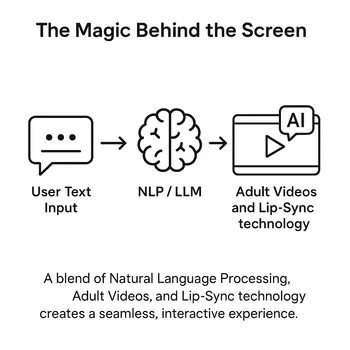
An AI girlfriend video chat is not a live human, not one long pre-recorded video, and not a deepfake of someone who didn’t consent. It’s three separate AI systems working as a relay team, in real time:
- The brain: a large language model reads your message (plus the conversation so far) and writes her reply in character.
- The voice: a neural text-to-speech engine turns that reply into audio in her unique voice.
- The body: a video engine selects and stitches motion so she keeps moving, reacting and speaking on screen without a single visible cut.
Each part is interesting on its own, but the real magic — and the hardest engineering — is making all three finish their work in about the time it takes a human to start talking. Let’s take them one at a time.

Step 1: The Brain — How She Decides What to Say
Underneath every AI girlfriend is a large language model (LLM) — the same family of technology behind the famous chatbots, but with two big differences.
First, the model runs with a persona: a detailed character profile describing who she is, how she talks, what she likes, and how flirty or shy she should be. Your message is never answered by a generic assistant; it’s answered by her — the model is instructed to stay in character the whole time. That’s why two different characters on the same platform will react completely differently to the same message.
Second, adult platforms use models without the corporate content filters. Mainstream assistants are trained to deflect anything romantic or explicit; companion platforms run open models that are allowed to flirt back. (There are still hard safety limits — more on that below.)
One thing that surprised me: for video chat, speed beats size. A giant model that takes eight seconds to answer would kill the illusion of a live conversation, so the engineering priority is a model that writes a good, in-character reply in well under a second. Memory of your earlier conversations is layered in as context, so she remembers your name, your dog, and that thing you told her last Tuesday.
Step 2: The Voice — Why She Sounds Human (and Answers So Fast)
Once the reply text exists, a neural text-to-speech engine speaks it aloud. Every character has her own voice profile — pitch, timbre, accent, speaking style — so the voice stays consistent across every session. Modern neural voices handle the small human details that old-school computer voices butchered: breathing pauses, sentence melody, that little smile you can hear.
Here’s a clever detail I learned that you’d never notice as a user: voice caching. Phrases the character says often — greetings, laughs, common reactions — have already been generated at some point for some user. Instead of paying to synthesize “Hey babe, I missed you!” for the ten-thousandth time, the platform recognizes the repeat and serves the stored audio instantly. Fresh, never-said-before sentences get synthesized live in a few hundred milliseconds. The result: replies feel instant, and the voice never varies mid-conversation.
The audio is also compressed before it reaches you — video chat is already bandwidth-hungry, and nobody wants their mobile data plan devoured by a flirty voice note.
Step 3: The Body — The Clip-Graph Secret
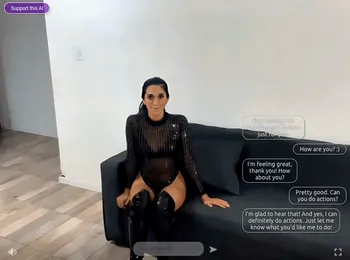
Now the part everyone actually asks about: the video. Here’s the honest engineering reality of 2026 — generating photorealistic video from scratch, frame by frame, in real time, is still too slow for a live conversation. Text-to-video models make stunning clips, but they take seconds to minutes per clip. You can’t hold a conversation with a loading spinner.
So real-time platforms use something smarter: a motion library with a clip graph. Think of it like the animation system in a modern video game, but built from photoreal footage instead of 3D models:
- Each character exists as a library of thousands of short motion segments per scene — idling, smiling, waving, leaning in, dancing, speaking, and everything the action menu offers.
- A graph records which segment can seamlessly follow which: if her hand is on the couch at the end of one clip, the next clip must start with her hand on the couch. The engine only ever travels along valid edges of this graph.
- Transition frames bridge the remaining tiny mismatches, so your eye never catches a jump. The player is literally swapping video segments in front of you, continuously, and it’s designed so you can’t tell.
- When she speaks, lip-sync technology matches her mouth to the generated audio, so the voice from step 2 and the face on screen agree.
All of these segments are pre-produced and distributed on a content delivery network, so the next clip is usually already buffering on your device before the current one ends. That’s why the video keeps flowing even while the AI is still “thinking” about her reply — the engine simply keeps her alive with natural idle motion, exactly the way a real person keeps breathing and shifting while listening to you.
Once you know this, you can’t unsee it — and honestly, it makes the experience more impressive, not less. The system is playing a continuous, branching, lip-synced film that reacts to your words, assembled live, just for you.
Putting It All Together: The Two Seconds After You Hit Send
Here’s the full relay race, roughly on a stopwatch:
- 0.0s — You hit send. Your message travels to the server; safety filters give it a first pass.
- 0.1s — The brain starts writing. The language model receives your message, the persona, and the conversation memory, and drafts her in-character reply.
- 0.8s — The voice kicks in. The reply is checked again, then either served from the voice cache or synthesized fresh in her voice.
- 1.2s — The body gets its cue. The video engine finds a path through the clip graph from whatever she’s doing right now to a speaking segment, and the lip-sync locks her mouth to the audio.
- ~1.5–2s — She answers. On your screen it looks like one uninterrupted moment: she heard you, thought about it, and replied.
During those two seconds, the player never froze — she kept moving through idle segments the whole time. That continuity is what your brain reads as “presence”, and it’s the single biggest difference between video chat and a text chatbot with a profile picture.
The Guardrails You Don’t See
A part of the pipeline that rarely gets talked about: safety filtering runs at every stage. Messages are screened against blocklists and patterns before the AI answers, and the AI’s own output is screened again before a voice is ever generated. Anything involving minors, violence, or other hard-line categories stops the pipeline cold. Add the age verification gate in front of the experience, and there’s a lot of invisible machinery whose only job is keeping the fantasy inside legal and ethical lines. In my book, a platform investing in this is a feature, not a footnote.
Why Not Fully AI-Generated Video (Yet)?
You might wonder: if AI can generate video now, why bother with clip libraries at all? Two reasons: latency and cost. Real-time means 24+ new frames per second, every second, forever — today’s generative video models simply can’t do that at photoreal quality for a consumer price. What platforms can do already is generate custom images and videos on demand when you’re willing to wait a bit — Xeve.ai does exactly that alongside the live chat, and I’ve written about how AI video generation works separately.
My prediction: the two approaches will merge. Clip-graph engines will handle the real-time layer while generative models produce new segments in the background, personalizing the library to you. The first platform that pulls that off seamlessly will feel like science fiction.
Don’t Take My Word for It — Try the Pipeline Yourself
The best way to understand all of the above is to watch it happen. This is a live preview chat with NahirRouge — the same character from the screenshot earlier. Send her a message and count the seconds: brain, voice, body.

Frequently Asked Questions
Is AI girlfriend video chat a real person?▼
Is the video live or pre-recorded?▼
Can my AI girlfriend see or hear me through my camera?▼
Why does she respond so quickly?▼
Is AI girlfriend video chat private?▼
Can I try AI girlfriend video chat for free?▼
Final Thoughts
“How does AI girlfriend video chat work?” turns out to have a genuinely satisfying answer: a language model for the mind, neural speech for the voice, and a clip-graph video engine for the body, all racing to finish inside two seconds so the illusion never breaks. No hidden camgirl, no stolen faces — just an unreasonable amount of engineering in service of one goal: making you feel like somebody is actually there.
If you’re new to all this, start with my primer What Is an AI Girlfriend?, or jump straight into a full AI girlfriend video chat and see whether two seconds of latency can carry a spark. In my experience? It can.